
Woodbury County Court Records After Arrest
The arrest-to-court path in Woodbury County crosses the jail roster, the Woodbury County Attorney, and Iowa Judicial Branch records. The jail roster may show the booking charge, bond amount, and booking time. It does not provide case disposition. Once the prosecutor files charges, the court record becomes the source for formal charge status, hearing dates, court orders, pleas, dismissals, convictions, and sentencing.
Use Woodbury County jail inmate records for current custody and booking details. Use Woodbury County jail mugshots for booking-photo questions. Court records after a jail arrest answer a different question: what case opened after the arrest, what charges were filed, and what the court has done with those charges.
From Booking Charge to Court Charge
A booking charge is the offense label entered during jail intake. It may come from an officer, a warrant, a court order, or another agency. A filed charge is the prosecutor's formal court accusation. In Woodbury County, the official County Attorney page says the County Attorney is the chief prosecuting attorney and prosecutes state law violations that occur in the county. Law enforcement agencies forward criminal state law violations to that office for review and prosecution.
The office is led by County Attorney James Loomis and is located in the Law Enforcement Center, lower level. The County Attorney's page also says the office does not represent private individuals, give private legal advice, prepare private legal documents, or investigate crimes. That limit matters. The prosecutor's office is part of the court-charge process, but defense advice and case strategy come from an attorney, not from the prosecutor or jail.
Find Court Records After Jail Arrest
Start with the public jail information only long enough to capture spelling, date, charge text, and bond status. Then move to Iowa Courts Online for the court docket. Direct court-search field inspection was blocked during research, so unsupported field labels should not be invented. Search by defendant name or case number if the portal exposes those options, and use the Woodbury warrant search court number when one is available.
The Iowa Courts Online search page is the state court entry point after the jail booking record points to a formal case.
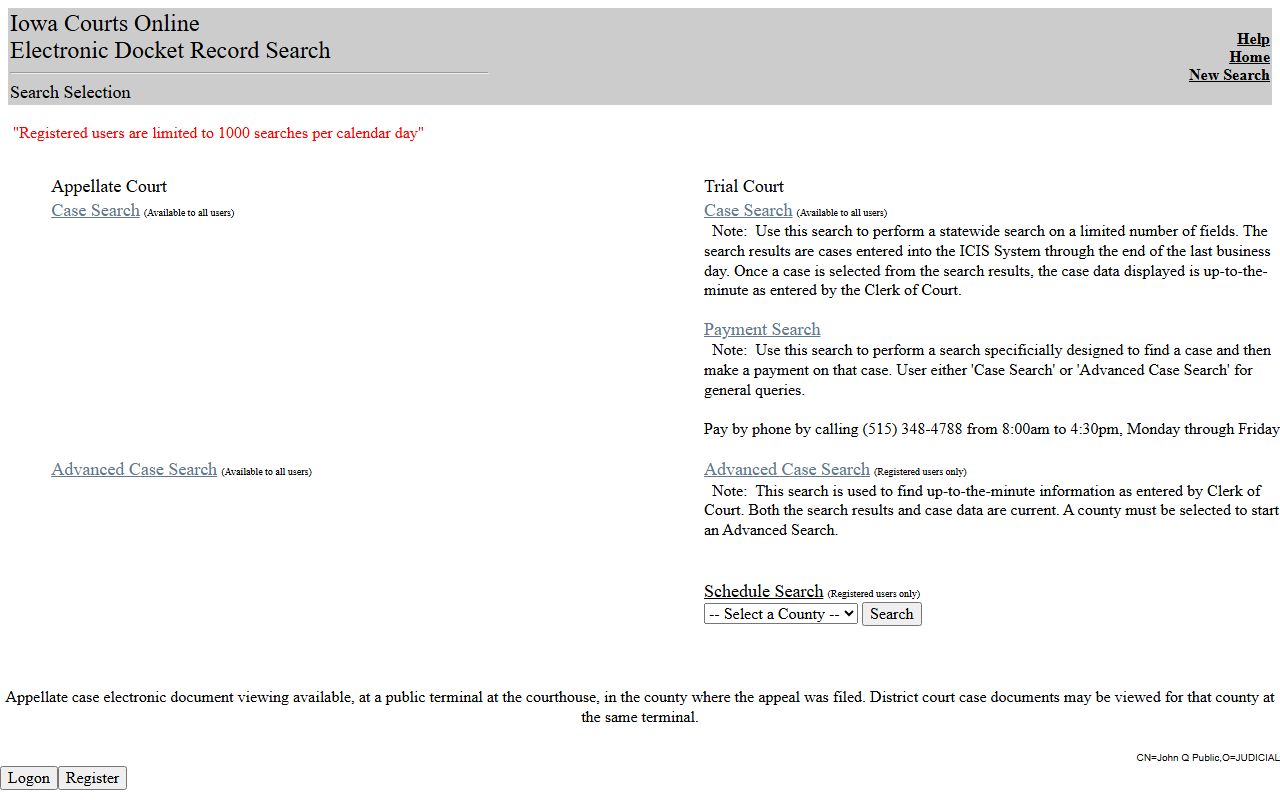
The court portal is separate from the jail roster, which is why charge status and disposition should be verified in court records.
- Search the Woodbury County In Jail Search for name, booking date, charge text, and bond amount.
- Check the Woodbury County Warrant Search if the booking involved failure to appear, probation violation, or a foreign warrant.
- Copy any court number exactly, including prefixes such as FECR, SRCR, AGCR, SMSM, OWCR, NTA, or STA.
- Search Iowa Courts Online for the defendant or case number.
- Contact the Woodbury County Clerk of Court for documents, older files, or items that require clerk or courthouse terminal access.
Woodbury County Court Contacts
Court records after a jail arrest are not all held by one office. The jail verifies custody and bond information. The prosecutor reviews and files charges. The clerk maintains district court filings and document access. Iowa Judicial Branch public-records guidance routes district court case filings to the clerk in the county where the case is filed.
Woodbury County Attorney
3701 28th Street, Lower Level
Sioux City, IA 51105
712-279-6516
Monday-Friday, 8:00 a.m. - 4:30 p.m.
Woodbury County Clerk of Court
620 Douglas Street, Room 101
Sioux City, IA 51101
712-279-6611
Clerk channel for case documents and court filings.
Charging Documents After Arrest
The charging document is the paper or electronic filing that turns an arrest into a court case. The research captured the core terms: complaint, information, and indictment. Not every Woodbury County case uses each type, and a charge can change after filing. The important point is that the court document, not the jail roster, controls the formal court record after arrest.
| Document | Plain Meaning | Why It Matters |
|---|---|---|
| Complaint | A charging document that starts many criminal cases | Often appears early after arrest or warrant activity |
| Information | A formal prosecutor charging document | Common for many felony and misdemeanor prosecutions |
| Indictment | A grand-jury charging document | Used when charges are brought through grand-jury action |
Charge Status in Court Records
Charges can be pending, amended, reduced, dismissed, or resolved by plea or trial. The jail record may still show the booking charge while the court record shows the filed or amended charge. That difference is normal. It is why the sheriff's roster disclaimer sends users to the arresting agency or Iowa Courts Online for accuracy and disposition.
| Status | What It Means |
|---|---|
| Booking charge | The charge or warrant reason recorded at jail intake |
| Filed charge | The formal charge submitted to the court by the prosecutor |
| Amended charge | A charge changed after filing, often by prosecutor action or court order |
| Dismissed | The court ended that charge without a conviction on that charge |
| Disposition | The current or final court outcome, such as dismissal, plea, conviction, or acquittal |
Bond Orders After Woodbury Arrest
The jail roster may show No Bond or a dollar bond amount, but the court order and jail verification control release. The official jail page says to call 712-279-6040 to verify bond amount and release conditions. Cash bond can be posted with the Woodbury County Clerk of Court during normal working hours, Monday through Friday, 8:00 a.m. - 4:30 p.m. After hours, cash bond can be posted with the jail.
| Bond Type | Woodbury County Routing |
|---|---|
| Cash bond | Posted with the Clerk during normal hours or with the jail after hours |
| Surety bond | The jail page points users to approved bondsmen, without naming private vendors |
| Personal recognizance | A court release status that should be verified in court records |
| No bond or hold | Payment may not release the person when a warrant, detainer, federal hold, or court order applies |
Warrants and Court Records After Arrest
The Woodbury County Warrant Search is a valuable bridge between jail and court records because it can show a court number, issue date, charge, crime class, bond, and photo status. The page title includes "Unverified," so the result should not be treated as final warrant status. Confirm with the court or sheriff before relying on it. A warrant can be recalled, served, or changed after the web result was last updated.
Warrant rows may include FTA, probation violation, foreign warrant, or offense shorthand. Copy the court number exactly into Iowa Courts Online when possible. If a person is arrested on a warrant, the booking may appear in the jail roster while the warrant court number helps locate the related court record after arrest.
Charges, Convictions, Sealed Records
Woodbury County court records after a jail arrest should not be read as proof of guilt. A charge is an accusation. A conviction is a court outcome. Sealing and expungement are also different concepts, and eligibility depends on Iowa law, the specific case, and court orders. The research did not locate a Woodbury policy promising automatic removal of jail photos or records after dismissal.
| Term | Meaning | Practical Effect |
|---|---|---|
| Charge | An allegation filed or listed after arrest | Can be pending, amended, dismissed, or resolved |
| Conviction | A guilty plea, verdict, or other adjudication of guilt | Can affect sentencing, supervision, and criminal-history records |
| Sealed | Public access is restricted by law or court order | Some agencies may still retain limited access |
| Expunged | Record access or treatment changes under an expungement order | Requires checking the court order and Iowa rules for the specific case |
DCI Criminal History Checks
Iowa DPS/DCI criminal-history checks are separate from Woodbury County court dockets. Use DCI when a statewide Iowa criminal-history record check is needed. The DCI page says requests can be made online, by mail, fax, email, or in person, but not by phone. Each request must include first name, last name, and exact date of birth.
| DCI Detail | Rule |
|---|---|
| Minimum identifiers | First name, last name, and exact date of birth |
| Fee | $15 per last name requested |
| Phone requests | Not accepted |
| Processing time | Often 1 to 3 days, with FAQ language noting two to five business days from receipt |
| Release limits | Completed deferred judgments, older arrests without disposition, and most juvenile records may be limited |
Restricted Court Records After Arrest
Not every record tied to an arrest is public online. Iowa Chapter 22 has public-record rights, but it also recognizes confidential records. Juvenile records, law-enforcement investigative material, protected personal data, sealed court files, and some records involving mental health, victims, or ongoing investigations may be restricted. If a case cannot be found online, the next step is not to assume it does not exist. Contact the clerk for court documents, the sheriff for jail records, or the responsible state agency for DOC or DCI records.
Important: Court records after an arrest can change quickly. Verify urgent charge, hearing, bond, or release questions with the clerk, court, jail, or attorney.